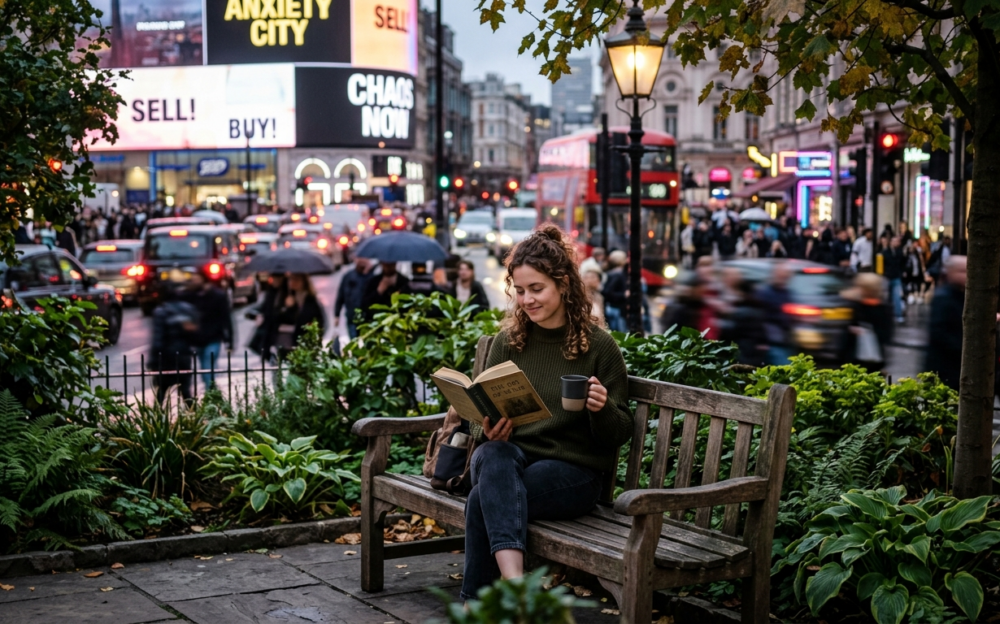

There’s a particular kind of exhaustion going around right now, and it’s not the kind that a good night’s sleep will fix.
It’s the exhaustion of keeping up. Of waking up each morning not quite knowing what fresh chaos the day is going to deliver. Of watching the world lurch from one crisis to the next while that low-level hum of anxiety sits in the background, even on the good days.
If you feel it, you’re not imagining it. And you’re definitely not alone.
I’ve spent a lot of time over the years thinking about what it means to live well, through music, through writing, through the inevitable hard stuff that life throws at all of us and right now, in 2026, I think a lot of people are genuinely struggling to find their footing.
This is not because they’re weak or broken, but because the world has become legitimately harder to navigate.
Political instability, economic uncertainty, environmental anxiety, the relentless noise of social media pumping all of it directly into your brain around the clock.
Previous generations had their own hardships but they weren’t dealing with existential global chaos delivered in real time to a device in their pocket. This is something different.
Something heavier.
And yet life goes on. Your life goes on. You still have to show up, maintain relationships, look after your health, and find some reason to keep moving forward.
Which brings me to the question that this is really about: how do you stay sane when the world around you seems to have lost the plot?
The answer isn’t to pretend everything is fine. And it isn’t to disengage from reality entirely. It’s something more practical and more sustainable than either of those options.
What “Staying Sane” Actually Means
Before anything else, it’s worth being honest about what we’re actually aiming for here.
In this context, staying sane doesn’t mean feeling calm all the time. It doesn’t mean being unaffected by what’s happening in the world, or walking around in some kind of meditative bliss while everything burns.
Real sanity looks more like this: you’re grounded enough to function. You can think clearly when you need to. You’re not constantly reactive or on edge. You have enough inner steadiness that when difficult things happen, and they will, you can face them without completely falling apart.
I think of it like swimming in a fast river. The current is still strong. The water is still cold. But you’re moving with some intention rather than just being carried wherever it takes you.
Just enough stability to keep living your life well, even when the world outside is doing its worst.
That’s the goal.
Why This Era Feels So Different
The human nervous system is remarkably well-designed for handling threat but the kind of threat it evolved to handle was immediate and local. A physical danger. A conflict within your community. You’d face it, get through it, and then gradually return to baseline.
What we’re up against now is something it was never built for: sustained, ambient, global threat. A kind of threat that never fully resolves. Where one crisis bleeds into the next before you’ve even processed the last one.
Layer on top of that the way we consume information today. Social media algorithms are specifically designed to surface content that provokes strong emotional responses (fear, outrage, anxiety) because that’s what keeps you engaged.
So not only is the world genuinely more destabilising right now, the platforms we use to stay informed are actively amplifying the worst of it and feeding it to us on a loop.
Your brain can’t easily distinguish between watching a news story about a crisis happening on the other side of the world and being physically present in that crisis. It responds to both with cortisol and adrenaline, with tension and vigilance.
When that response never fully switches off, you end up carrying a chronic stress load that wears you down even when nothing is directly wrong in your own life.
I’ve really noticed this in myself. There are days when I haven’t done anything particularly stressful, but by evening I feel depleted. Usually, if I trace it back, it comes down to how much of the outside world I’ve let in that day without any real filter.
Understanding this doesn’t make the anxiety disappear but it does make it make sense and that’s the real kicker here, because it means the solution isn’t something flippant like think more positively or just toughen up.
It means actually doing something about it, at the level of both the mind and the body.
It’s Time To Draw Your Circle
One of the most useful mental frameworks I keep coming back to comes from the Stoics, and it’s deceptively simple: there are things within your control, and things that aren’t. Your energy goes where your attention goes and most people are pouring enormous amounts of mental energy into things they have absolutely no power to change.
Global politics. What world leaders decide to do next, whether the economy tanks, what some public figure says or does, these all sit outside your circle of influence.
Watching them, analysing them, catastrophising about them, none of it changes the outcome. It just costs you your mental health and your perspective.
Now, inside the circle is a far different story.
Your attention, your habits, how you respond to what happens around you, the quality of your relationships, how you spend your time, what you create, how you treat yourself. These are things you can actually work with.
Try this: take a piece of paper and draw two circles, one inside the other.
In the inner circle, write down everything that genuinely sits within your control. In the outer ring, write everything you’re currently spending mental energy on that you can’t actually change.
Most people find the outer ring is enormous. Crowded with things they’ve been carrying around for months. Things that feel urgent but are, in terms of personal agency, completely out of reach.
This isn’t about being passive or indifferent to the state of the world. It’s about being honest about where your energy can actually do something useful and pulling it back from everywhere else.
Guard What You Let Into Your Life
Did you know that you have more control over your information diet than you probably realise?
The goal isn’t to stick your head in the sand or become uninformed. It’s to be intentional about how much you consume, when you consume it, and what you do with it. There’s a real difference between staying informed and being saturated.
A few things that have made a genuine difference for me. For one thing, I don’t watch TV anymore, especially the news programs. If I am to consume information I mostly watch YouTube as I can control what I want to see and hear plus I have far greater choice of what information I consume.
I generally find that the news will find me if it’s important rather than the other way around.
There’s also a distinction worth making between news that genuinely informs you and news that just agitates you. Some things are worth knowing. Others are just noise dressed up as urgency.
You’re allowed to tell the difference.
I audit my social media feeds honestly not for political reasons, but for mental health reasons. Ask yourself how you feel after spending time with a particular account or platform. Lighter and more informed? Or anxious, irritated, and vaguely hopeless?
If it’s consistently the latter, that’s useful information. Mute, unfollow, or limit without guilt.
This is a dial, not a switch. You don’t have to choose between being fully plugged in and completely disconnected. You just have to find a setting that doesn’t leave you hollowed out by lunchtime.
Get Back In Your Body
Here’s something that doesn’t get said enough in conversations about stress and anxiety: you cannot think your way to calm.
You can understand why you’re stressed. You can intellectually know that things will probably be okay. But if your body is stuck in threat mode, all that understanding sits in your head while your body stays tense, your sleep stays disrupted, and that background hum of anxiety keeps running.
Peace of mind is also a physiological state, not just a mental one. When the body feels safe, the mind follows. When the nervous system is regulated, genuine calm becomes possible.
The practices that help with this are simple. Not easy necessarily, but simple…
Slow breathing with longer exhales signals safety to your nervous system, it’s one of the fastest ways to shift out of fight-or-flight.
Walking, especially outside and without headphones, has a grounding effect that no screen can replicate.
Time in nature. Gentle movement. These aren’t luxuries or rewards, they’re maintenance activities for a calm mind and body.
For me personally, music has always been one of the most powerful ways back into the body and out of my head. Playing, writing, recording and even just listening with real attention rather than as background noise.
It pulls me into the present moment in a way that very little else does. Whatever that thing is for you, find it and use it, especially on the hard days.
As John Lennon once sang… “Whatever gets you through the night, it’s alright, it’s alright”
Find Your Anchors
When the world feels chaotic and unpredictable, the antidote is usually found in the small and the consistent.
Anchors are the things that keep you tethered to yourself when everything else is shifting and they vary from person to person.
For some it’s a morning routine, for others it’s creative work, time with people they love, being out in nature, or something as simple as making a good cup of coffee and drinking it without looking at a screen.
What matters isn’t what the anchor is. What matters is that it’s reliable and that it’s something that belongs to you and isn’t dependent on what the world decides to do next.
Think about your anchor(s). What are the things that, when you do them, leave you feeling more like yourself? More settled? More connected to something real?
Make a short list. Then treat those things as non-negotiable, not as rewards you earn after everything else is handled, but as the foundation that makes handling everything else possible.
For me, creative work is a particularly powerful anchor. Making something like a song, a piece of writing, a recording, anything is an act of agency in a world where so much feels out of your hands.
I’ve found that on the days when I create something, even something small, I feel less at the mercy of whatever is happening out there. It’s a quiet but real reminder that you’re still here, still moving, still building something.
Stop Waiting For The World To Calm Down First
This one is worth just sitting with.
How much of your peace of mind are you holding hostage to circumstances that may never fully resolve? “I’ll relax when things settle down.” “I’ll feel better when there’s less uncertainty.” “Things will go back to normal eventually.”
Maybe. But waiting for the world to calm down before you allow yourself some inner peace is a strategy that could keep you waiting for a very long time. There may not be a clear moment when everything is resolved and safe enough to finally exhale.
The shift that changes things is this: your inner stability doesn’t have to wait on external circumstances.
You can decide, right now, to tend to your own mental and emotional health regardless of what’s happening out there. Not because the world doesn’t matter, but because you matter too. And because you’re genuinely more useful to yourself, to the people around you, to whatever you’re building when you’re not running on empty.
Hey! You’re Still Here
Living through a genuinely difficult and disorienting period of history is hard. There’s no use pretending otherwise. The anxiety that a lot of people are carrying right now isn’t irrational, it’s a reasonable response to a world that has become harder to read and harder to trust.
But humans have always lived through chaotic periods. Wars, plagues, economic collapses, political upheaval and within all of that, people found ways to stay connected to themselves and each other.
To create meaningful things. To keep going with some sense of intention and even, sometimes, joy.
I think about that quite a bit. The people who kept writing, kept playing music, kept building things and raising families and finding beauty in the ordinary, even in the middle of extraordinary difficulty. That certainly takes some courage to keep on living.
The world outside may stay noisy for a long time yet. You can’t control that but you can tend your own corner of it.
- Guard what you let in.
- Get back in your body.
- Draw your circle and stay inside it.
- Find your anchors and hold onto them.
Do that consistently, imperfectly, and without waiting for the world to give you permission because THAT is how you stay sane in an insane world.
Peace,
Corey 🙂